Michigan Interstate(Designated-Operator of Ann Arbor RR - 1977 to 1988) |
||||
|---|---|---|---|---|
 | ||||
To those who knew her and were more than casual observers, the Ann Arbor railroad, had it
all -- Alcos, a "navy," and roller coaster profile in the northern part of Michigan. Although
the popular rail line declared bankruptcy in 1976, its character lived on for a dozen years
in the form of the Michigan Interstate Railroad. It should be noted that Conrail during a brief
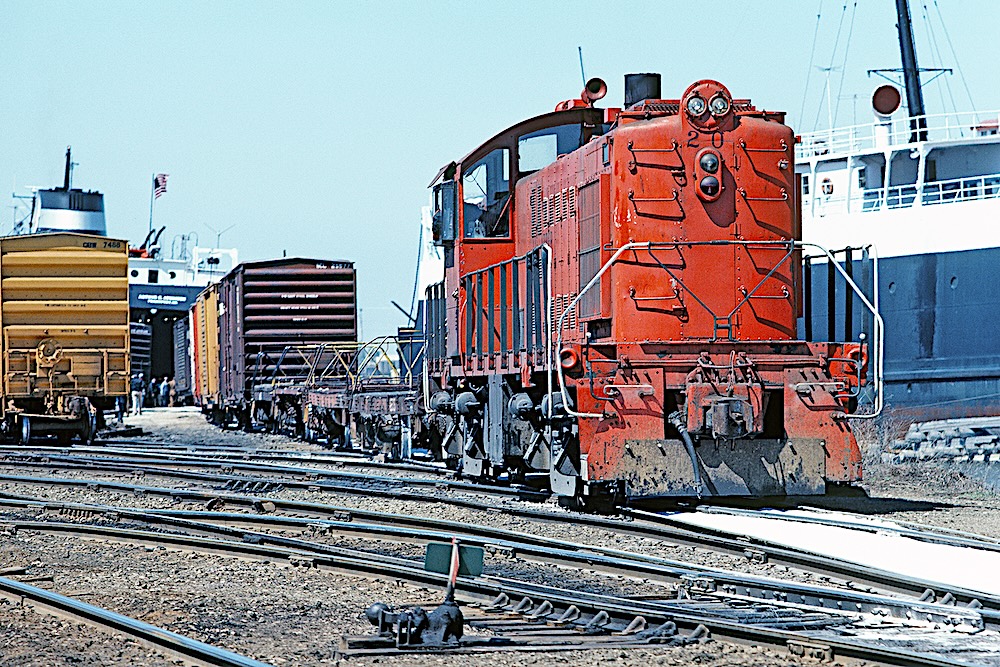
interim managed the railroad prior to MIRC's 1977 start-up. The above image depicts Alco-built
RS1 #20 spotting cars at the Elberta, Michigan boat yard - Forrest L. Becht photo in April 1982.
To briefly recap, the "Annie's" main line stretched northwesterly 293 miles from Toledo, Ohio to the boat yards at Elberta, Michigan. For some shippers, the railway as a short-cut between Lake Erie and Wisconsin and a valured by-pass of prolonged Chicago metroplex delays. Prior to the arrival of EMD-built GP35s in 1964, the AA relied heavily on an Alco-intensive fleet of FA2s, RS1s, S1 and S3 switchers, along with a lone 44-ton Whitcomb. The only Alcos to survive the bankruptcy were the RS1s and S3s; however, AA/MCIR did later acquire two surplus RS2s from the Green Bay and Western. | ||||
| Photo Gallery | ||||
Forrest Becht (MCIR engineer, chief mechanical officer 1981-198x), provides an insider's view
of the Michigan Interstate Railroad in both photos and captions.
|
||||
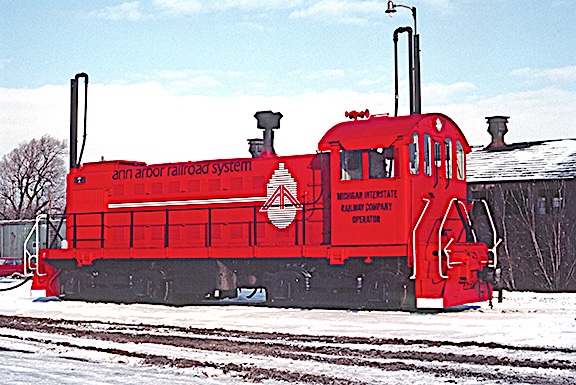
The Ann Arbor roster initially consisted of nine switchers that had been delivered direct from
the Alco plant in Schenectady, New York, during 1944, 1950 and 1952. They were S1s #2 & 3 plus
seven S3s #4-10 ; both models were rated at 660-horsepower. The primary difference was the S3s
rode on AAR Type-B trucks, rather than the blunt-type trucks found beneath the S1s. Only #6 and
7 survived long enough to be part of the AA/MCIR roster. ( Right photo -- Alco #7 was out
of the Owosso, MI shops with an engine rebuild and a fresh paint job in November 1981. The Alco
S3 was generally used for yard work at the railroad's central Michigan location.)
|
 |
|||
Ann Arbor's first road diesels were two RS1s #20 and 21 delivered by Alco in the latter part of
1950. Although equipped with steam generators, the pair arrived too late to pull the railroad's
regularly scheduled varnish which had been discontinued a few months earlier. Subsequently the
1000-hp road-switchers spent the next three decades in local freight and yard duties, including
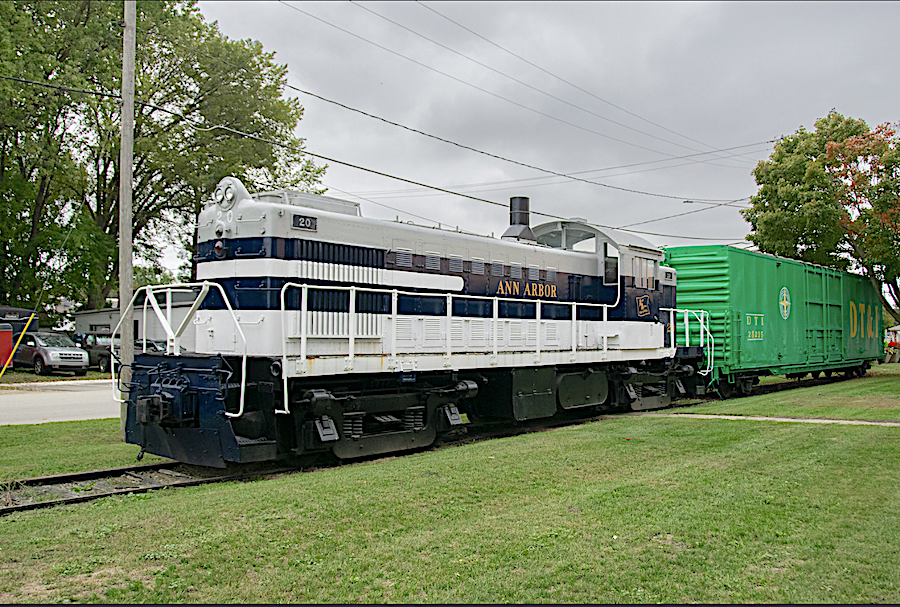
working the boat docks in Elberta, MI. Interestingly, both of the seventy-year-old Alcos still exist.
The #20, adorned in its original Wabash Railway colors, is a static display in Shepard, MI;
sister #21 is slowly undergoing restoration at Lenawee Jct., MI by the Southern Michigan
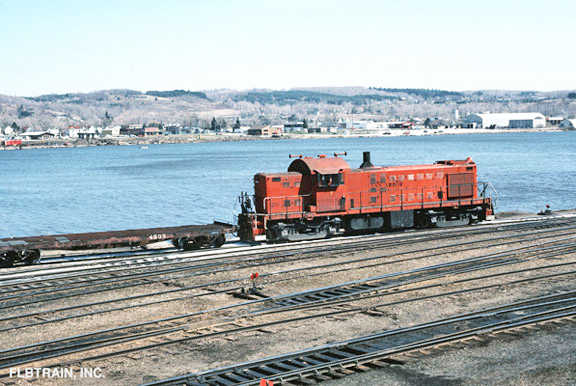
Railroad Society when time and money permits. (The photo at right is another view of RS1 #20
working the boat dock area in April 1982.) |
 |
|||
The annals of the Ann Arbor RR "navy" are storied; its rail car ferries had plied the waters
of Lake Michigan for nine decades; the end came in 1982 when AA/MCIR's subsidy was discontinued
by the State of Michigan. During that 90 years, the railroad had owned eight car ferries and
operated three separate routes from its terminus in Elberta, MI to Milwaukee, Manitowoc and
Kewaune, Wisconsin. Annual freight tonage was reported at 102-million tons a year (average). By
1976, the company's ownership of car ferries was down to two: The M/V Arthur K. Atkinson and
the M/V Viking. Both vessels had been built in the early 1920s, and were rebuilt during the
mid-1960s. MIRC had also temporarily leased the S.S. City of Milwuakee from the Grand Trunk
Western. |
||||
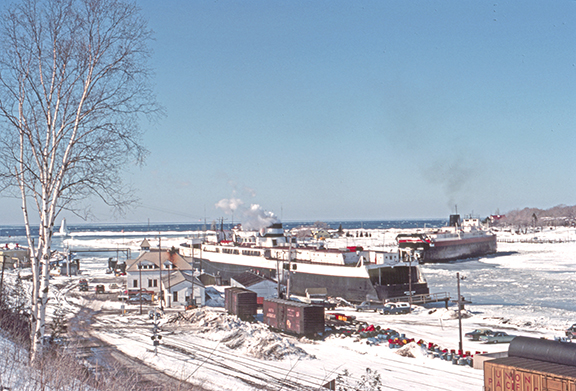 | 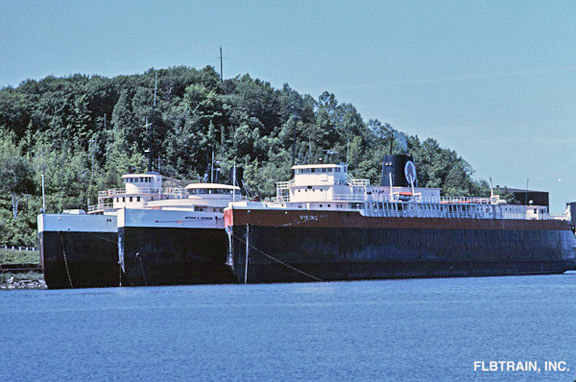 | |||
(Left photo -- Car ferry Viking turns in the Betsie Bay basin while the laid-up
Atkinson watches. The Viking was powered by four EMD 16-567 diesel engines. The Atkinson had
2-12 cylinder Nordberg diesels. Right photo -- All three car ferries were laid-up at
Elberta in 1982. From left-to-right, they are the City of Milwaukee [(]steam powered],
Atkinson, and Viking.) |
||||
In 1964, a wave of orangish-red paint washed over the Ann Arbor railroad; it coincided with the
transfer of Annie ownership from prior parent Wabash Railroad to the Detroit Toledo & Ironton.
Ten new EMD GP35s that arrived during April through June of that year were the first outward
appearance of the change in ownership. The EMD's which had supplanted railfan-favorite Alco FAs
remained the backbone of the Ann Arbor fleet well beyond the shutdown of the Michigan Interstate.
|
||||
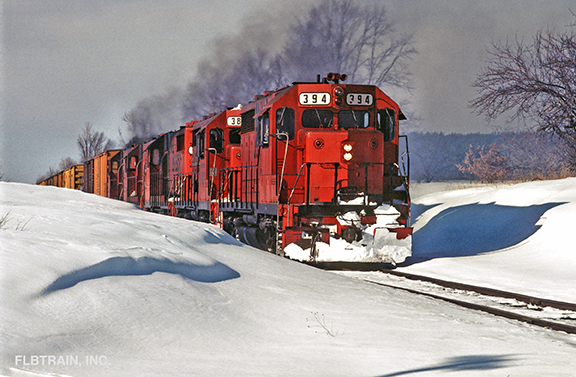 |
(Left photo -- Frankfort-Owosso train has no fewer than five Michigan Interstate GP35s
with #394 in the lead in March 1982. A ten-foot snow drift greets the southbound train as it
crests Boon hill at Yuma. The train originated in Frankfort/Elberta with boat traffic.
Generally it would make a pick-up of loaded foundry sand at the sand pits in Yuma. The sand
was destined for Cleveland where it was used by the vehicle manufacturers for casting engine
blocks. With the loaded sand cars, as well as the boat traffic, mainly loads of paper products
originating on the GBW in Wisconsin, the tonnage could run as high as 4,000-5,000 tons. Even with
four or five units, the grade gave the 35's a real workout. |
|||
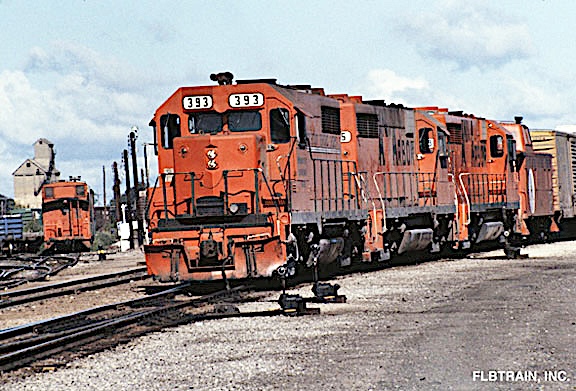
(Right photo -- Michigan Interstates' train OT90 (Owosso-Toldeo) with GP35s #393, 385 &
391, maneuvers its way through the Grand Trunk Western yard and past the old station in Durand,
MI duing August of 1982. The Annie had trackage rights on GTW through Durand until reaching home
rails at Pitt Jct to the south. The trackage rights dated back to 1885.
|
 | |||
| The Challenge | ||||
Forrest Becht, Michigan Intertstate chief mechanical officer shares his perspective on the
challenges the rail line faced entering the 1980s. "During the time I was there - 1981-1983.
Almost all of remaining cross-lake traffic was moving between the Ann Arbor and Green Bay &
Western. To avoid losing that business, the two Lake Michigan carriers chose not to sign a
national rate increase that other railroads had sought and won. Car ferry operations were
already expensive and trip-time through Chicago and around Lake Michigan was becoming less an
issue. These two factors could have led to significant drops in revenue which the two boat
wanted to avoid."
"As I recall, the State of Michigan had beeen subsidizing the Annie's boat operation which helped; however that financial assistance disappeared in a few short months. Michigan automakers had been experiencing a downturn in new car sales; when translated it meant substantially less tax revenue for the Michigan government. Those factors along with politics contributed to the end of the MIRC rail operations north of Ann Arbor." |
||||
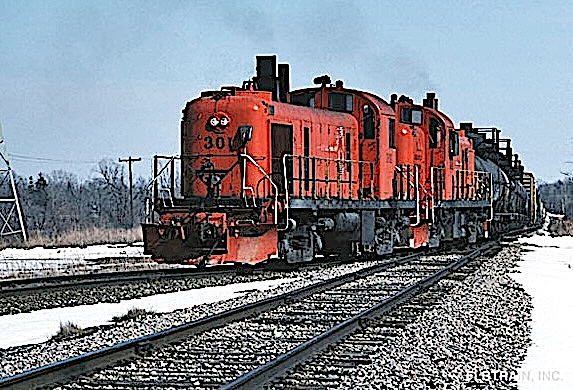
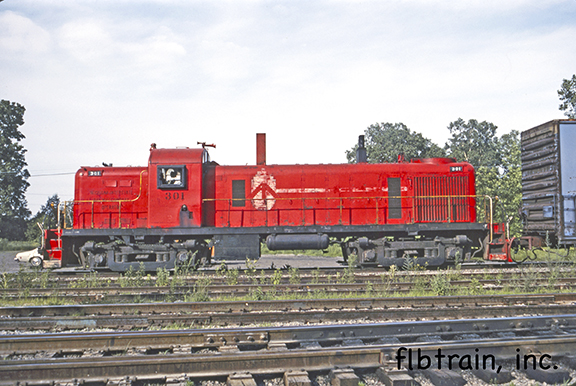
By 1979, the road worthiness was in question of a few of the rail line's 25-year-old GP35s, so
the railroad looked first to GB&W and purchased a pair of even older surplis Alco-buit RS2s.
The same two Alco had been previously leased to the Michigan Northern. Once on AA/MCIR property,
the Schenectady oldtimers were repainted and given a fresh of orangish-red dip with a large
logo on the long hood. The Alco road-switchers found retirement in 1985. In the waning months
prior to complete shutdown of the railroad, AA/MCIR 's only business was the Chrysler
Corporation/Jeep auto parts plant in Toledo. Traffic between the two locations was handled by
train TA-9 (Toledo-Ann Arbor).
(Left photo -- Alco RS2s 301 & 303 enter the yard lead at Owosso, MI with train TO-1
(Toledo-Owosso) in early spring 1982. (Right photo) RS2 #301, is about to depart
for the plant in Ann Arbor with high cube cars behind the engine. The railroad's final days
were rapidly approaching. |
||||
 |  | |||
| Footnote | ||||
It should be noted that both of the Ann Arbor/Michigan Interstate RS1s still exist. The #20
is an exhibit in Shepard, Michigan and was repainted just ten months ago. (See Robby Gragg
photo at right). Meanwhile, the #21 stands idle near Lenawee Jct. waiting for a future
restoration |
 | |||
--
|
||||
| 1 August 2026 | ||||