What's In A Name? East Coast EditionAll photos from the Krambles-Peterson Archive
Text by Art Peterson |
|
|---|---|
Use of distinctive names to identify the premiere train(s) on a route did not come into practice until nearly two decades after passenger trains first began operating in the US. The 1847 naming of the "Fall River Boat Train" is credited with beginning this practice, which reached its zenith around the time of World War One. As Bill Kratville noted in his superb book "Steam, Steel and Limiteds" these train names would become "household words." Thanks to the publicity skills of George Henry Daniels (and others), names like the "20th Century Limited" immediately suggested the notion of luxury, fine dining and the scenery of the water level route. The same was true of the many other fine named trains of the era. Even into 1950, the US still boasted some 350 name trains in operation. This series celebrates those once-familiar name trains on a regional basis. Each installment includes five trains, with the photos presented in chronological order. Since this feature is appearing on "The Diesel Shop" site, it also includes a variety of the diesels that were once in command of the name trains. Apologies if your favorite road/limited/locomotive model isn't included in this series. |
|
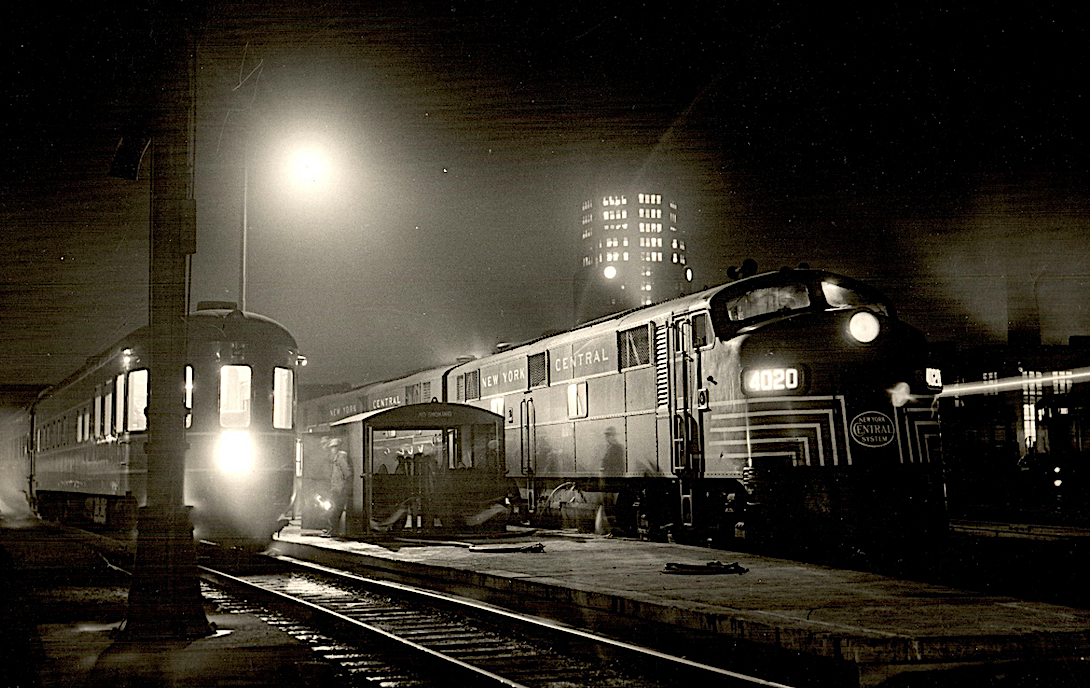
NYC "20th Century Limited" - WB Buffalo, NY - October 2, 1948 - NYC Photo
The company photographer captured this superb scene of the WB "20th Century" meeting EB
Train 8 the "Wolverine" at Buffalo. The "Wolverine" arrived in Buffalo at 1:10 am and was
due out of this station twelve minutes later.
This scene also nicely encapsulates the NYC's postwar passenger investment program, which was
reported in the February 1945 "Trains" as a 300-car order. Subsequent reporting by that
magazine noted the order had grown to 712 cars by October 1946. Each set of cars for the
post-war "20th Century" cost the NYC about $2 million, capped off by the classic Pullman-Standard
deep-end-window observation-lounge-sleeper cars. The E7s of the "Wolverine" demonstrate what
NYC ads were touting around the time of this photo - 26 of their mainline trains were now
dieselized.
E7 4020 had a long and eventful career. Built by EMD in April 1947 (serial 4175), the unit
was wrecked and rebuilt by EMD as an E8 in June of 1953. The unit survived the marriage of
the NYC and the PRR and became Amtrak 255. It was finally sold for scrap in July 1975.
|
|
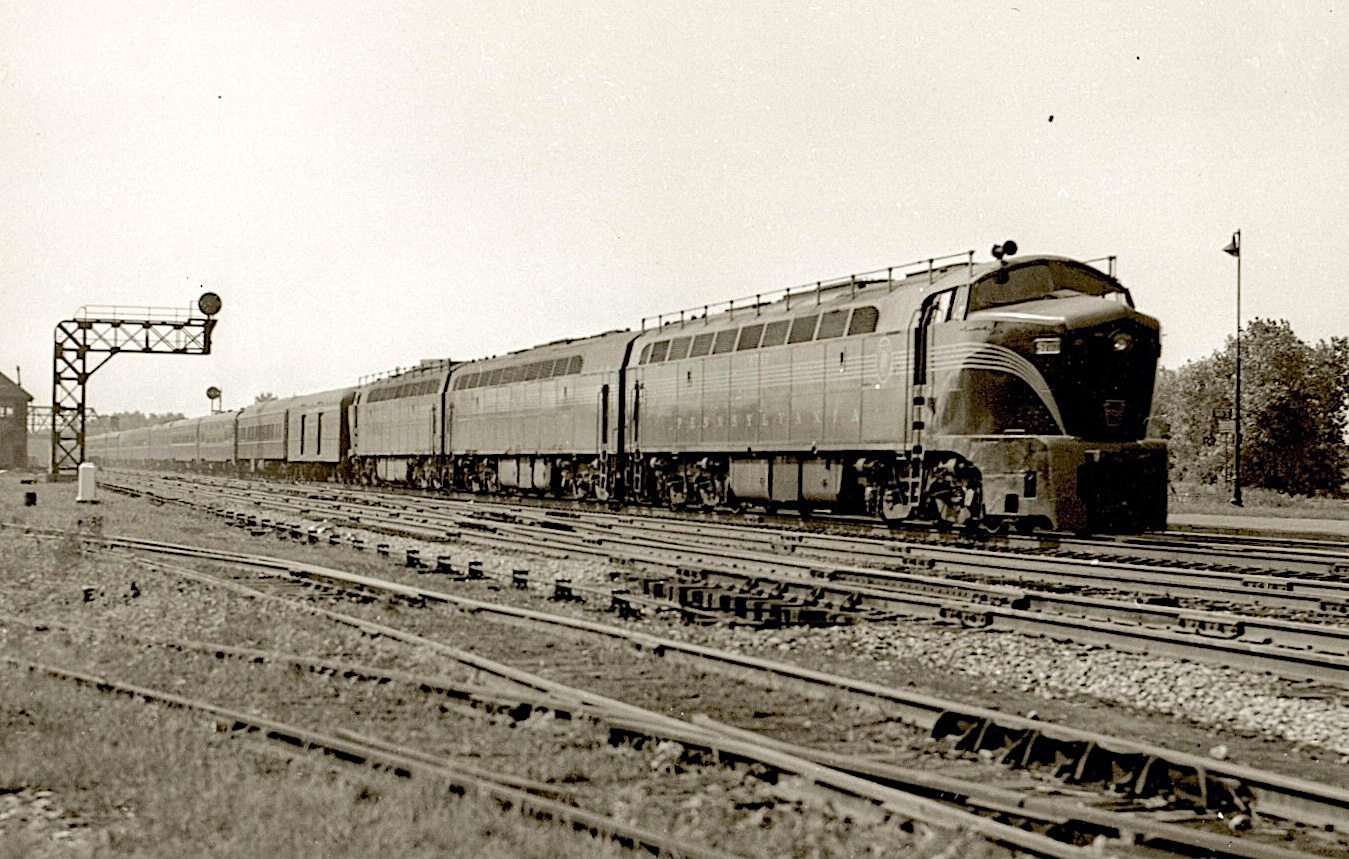
PRR DR-646-2000 5787 "The General" - EB Englewood, IL - July 31, 1952 - TH Desnoyers Photo
Pennsy inaugurated "The General" on April 25, 1937, naming the new train in honor of its
recently-deceased President, WW Atterbury. The train was essentially a second section of the
"Broadway Limited" - virtually its equal in terms of speed and amenities.
This train had been restored to all-Pullman status in January 1948. The 16-hour schedule was
resumed in June 1949, about the same time the train benefitted from PRR's significant post-war
passenger car purchases (214 cars at a cost of $20.5 million). Despite all these positive
developments, PRR's 1946 deficit forced management action. Over the next seven years, the
road slashed passenger train miles by 37%. One step in this initiative was the combining of
the "General" with the all-coach "Trail Blazer,"" effective September 30, 1951. Thanks to
actions like these, PRR's passenger deficit for 1952 was 15% less than it had been the previous
year.
Power for today's "General" is a rare A-B-A set of passenger "sharks."" Lead unit 5787 was
built by Baldwin in December 1948. Tom was lucky to catch this unit in passenger service,
as it was converted to a freight unit (PRR Class BF16z) later this year. It remained in
freight service until being retired in September 1962.
|
|
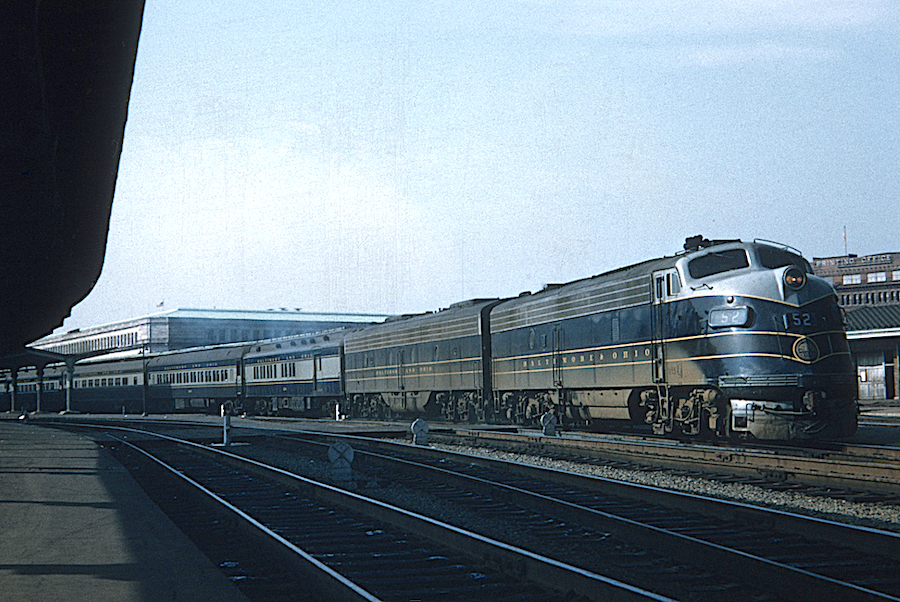
B&O E6 52 "Capitol Limited" - WB Washington, DC - 1955
B&O's reputation for unmatched hospitality, along with an exceptional dining experience
(Maryland Crab Cakes, Oyster Pie and Hush Puppies among its unique offerings) won it the
loyalty of important clientele in the Washington-Chicago market. The "Capitol" was THE train
in this market and B&O repeatedly re-equipped the train to maintain its attractiveness.
In addition to equipment bought new post-war, B&O took advantage of the active second-hand
market to augment its fleet. C&O's reduced passenger car needs allowed B&O to acquire
additional cars in 1950 and again in 1951. In 1954, B&O bought new "slumbercoaches" from Budd.
Around the time of this photo, a typical "Capitol" was a 12-car consist, including cars that
had come down from New York, as well as those added in DC. A transcontinental 10-6 sleeper
(handed off to the Santa Fe in Chicago) was still being handled.
Train 5 is led by 2nd locomotive 52, an E6 of October 1940. Re-numbered to 52A during 1950,
the unit re-acquired its original number in 1952. It was wrecked in a collision with a
landslide near Cornwallis, WV on May 31, 1956.
|
|
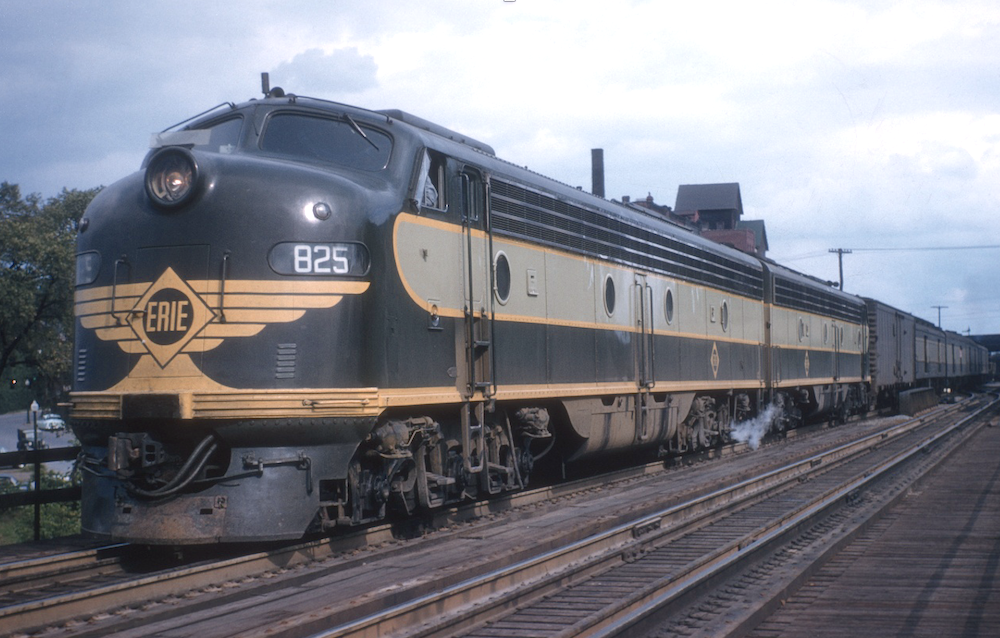
Erie E8 825 "Erie Limited" - WB Binghamton, NY - ca. 1956 - N McDonald Photo
There were many fine trains on the New York-Chicago run that weren-t surrounded by the
intense pressure that the NYC and PRR managements put on their flagship trains. The "Erie
Limited" had a reputation for providing comfortable accommodations and was generally uncrowded.
In addition, it offered the benefit of passing through some superb scenery in New Jersey and
Pennsylvania during daylight hours. The :Limited: carried Jersey City-Chicago sleepers and
added sleepers from Salamanca, Youngstown and Akron while en-route.
In this view it is shown during the 10 or so minutes it was due to dwell in Binghamton, NY
(due there around 1:50 pm). Lead engine 825 (EMD s/n 12223, built February 1951) sits on the
bridge over the Chenango River just west of the Erie depot. Erie worked their E8s intensively
- in late 1951, "Trains" noted that the locomotives that worked the "Erie Limited" into Chicago
had less than 3 hours to be serviced before being scheduled to depart with the eastbound "Lake
Cities."
|
|
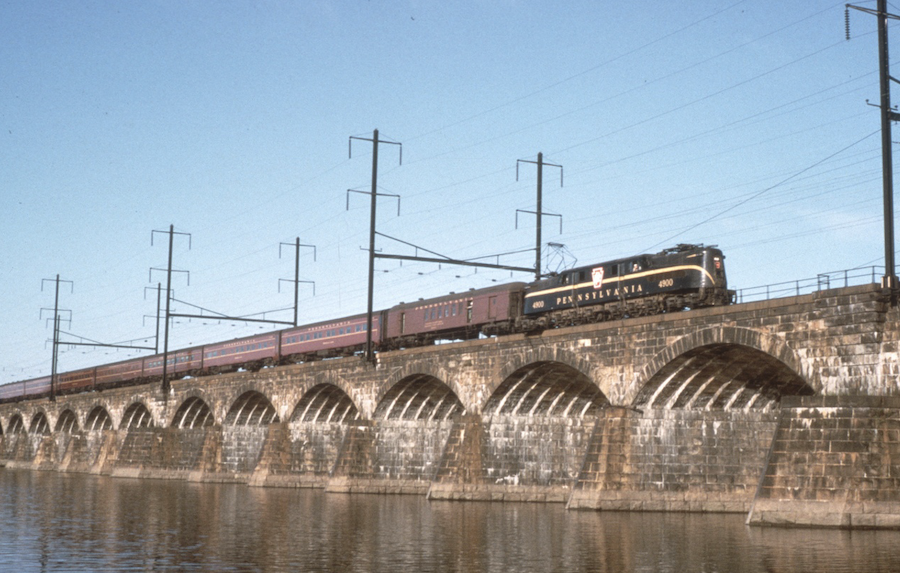
PRR GG1 4900 "Broadway Limited" - EB Trenton, NJ - ca. May 1963
The graceful Morrisville-Trenton Railroad Bridge is the setting for this portrait of the EB
"Broadway Limited."" The 18-span, segmental arch bridge was built between 1901 and 1903. Deep
bedrock and a series of floods slowed construction.
The early 1960s were interesting times for the PRR - the merger with the NYC was "on again,"
after having flopped back-and-forth. Just a year prior to this image, stockholders of both
roads had approved the merger and the two lines had filed their application with the ICC.
PRR management was committed to the "Broadway" - it remained an all-Pullman train even after
the Central had added coaches to the "Century" on April 27, 1958. There were challenges in
this approach - in mid-1961, it was noted the train was grossing $5 million annually, but this
was only two-thirds of what it needed to break even. In late 1967, PRR consolidated the
"Broadway" and the "General" eliminating the all-Pullman status of the great train. Management
estimated this move would save $1.4 million.
|
|
Acknowledgements: As noted in the introductory text, Bill Krattville's "Steam, Steel & Limiteds" was a valuable resource; as was Fred Frailey's "Twilight of the Great Trains." Joe Welsh's books on the B&O and PRR passenger trains were also of considerable use, as was Albert Churella's PRR History series. Back issues of "Trains" magazine and "X2200S," as well as "The Second Diesel Spotter's Guide,"" along with numerous websites (including the PRRT&HS "Chronologies"") were also consulted. In addition, Craig provided specific roster info.
|