What's In A Name? Pacific Northwest EditionAll photos from the Krambles-Peterson Archive
Text by Art Peterson |
|
|---|---|
Use of distinctive names to identify the premiere train(s) on a route did not come into practice until nearly two decades after passenger trains first began operating in the US. The 1847 naming of the "Fall River Boat Train" is credited with beginning this practice, which reached its zenith around the time of World War One. As Bill Kratville noted in his superb book "Steam, Steel and Limiteds" these train names would become "household words." Thanks to the publicity skills of George Henry Daniels (and others), names like the "20th Century Limited" immediately suggested the notion of luxury, fine dining and the scenery of the water level route. The same was true of the many other fine named trains of the era. Even into 1950, the US still boasted some 350 name trains in operation. This series celebrates those once-familiar name trains on a regional basis. Each installment includes five trains, with the photos presented in chronological order. Since this feature is appearing on "The Diesel Shop" site, it also includes a variety of the diesels that were once in command of the name trains. Apologies if your favorite road/limited/locomotive model isn't included in this series. |
|
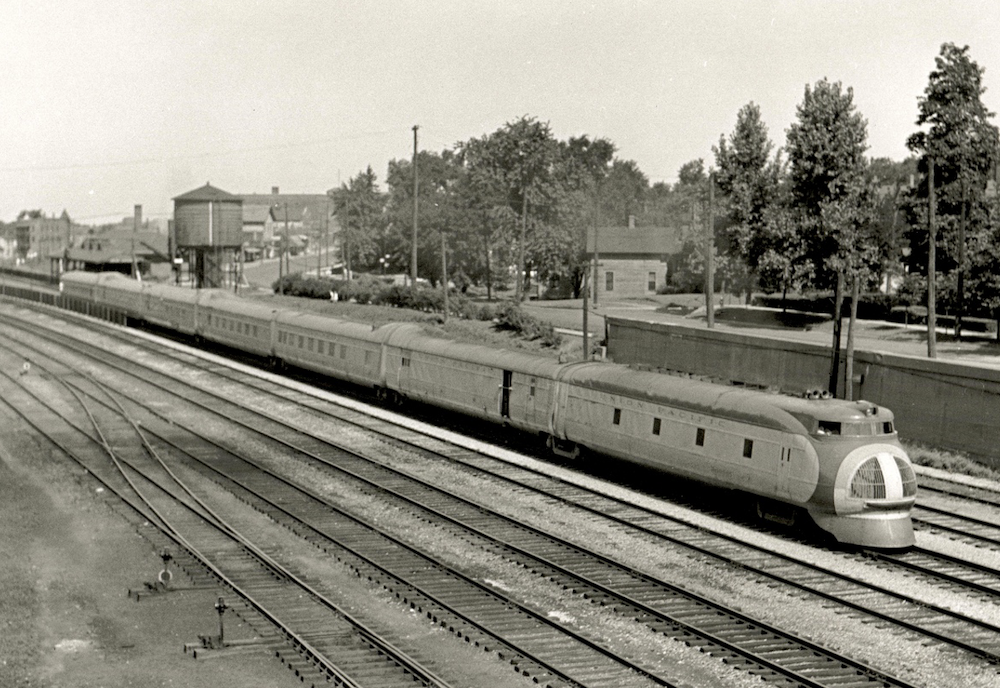
UP M-10001 "City of Portland" - EB West Chicago, IL - August 4, 1935 - AW Johnson Photo
Proof-of-Concept: the "Pioneer Zephyr" showed what could be done in the marriage of the Winton
201A diesel engine to a streamlined train made of stainless steel, but it took the Pullman-Standard
(P-S)-built M-10001 to demonstrate that the new trains could also be used to provide reasonable
overnight accommodations (three sleepers were in this 7-car trainset). Al Johnson was on the
Wilson Avenue bridge in West Chicago to catch the "City of Portland" on its final sprint into
Chicago.
Ordered by UP on June 30, 1933, P-S delivered the train to the UP in early October 1934, after
which it ran a series of demonstration runs/was exhibited. Returned to P-S for modification
in December of that year (it also traded its 900 hp diesel for a 1,200 hp installation), it
resumed service on the UP/C&NW routing in May 1935 (making its run on an every-fifth-day basis).
Scheduled for a 39.75-hour one-way running time, this was a full day faster compared to previous
schedules. Out-of-service from June 1939, the train was sold for scrap in August 1941. |
|
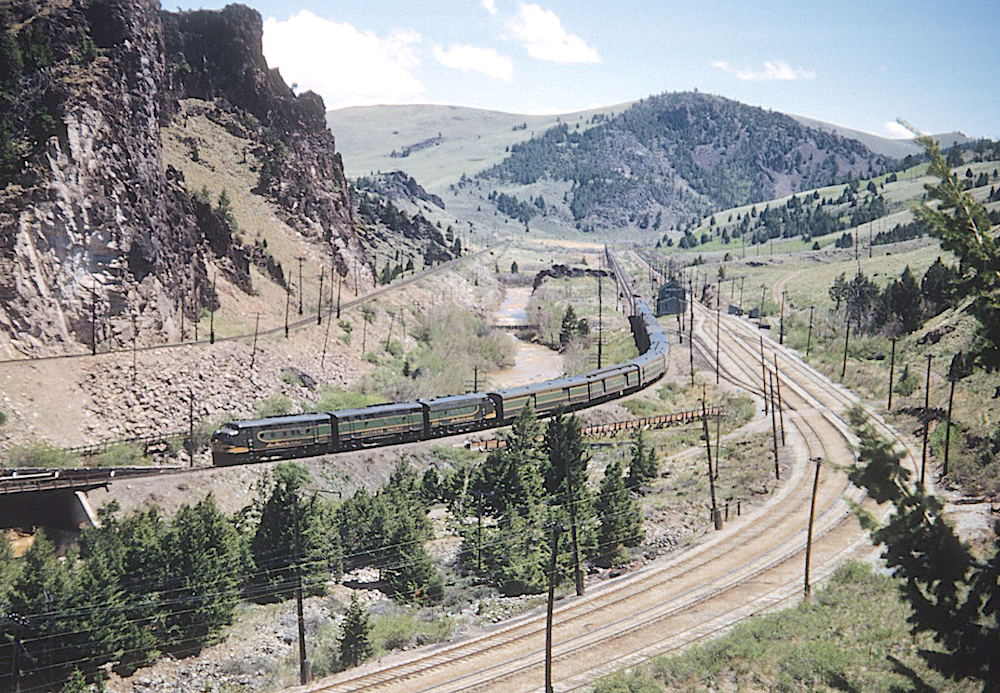
NP F3 6501A "North Coast Limited" - WB Durant, MT - May 28, 1951 - HM Stange Photo
One Crowded Canyon - tracks of three railroads (from right-to-left: Butte, Anaconda & Pacific
(BA&P), Northern Pacific (NP) and the Milwaukee Road) threaded through Silver Bow Canyon, west
of Butte, MT. The Milwaukee and the BA&P ran within sight of each other for 14 miles, starting
on the west side of Butte.
The NP's flagship train began operation on April 29, 1900 initially envisioned as a seasonal
operation, but quickly made a permanent part of the timetable. NP's famous "Big Baked Potato"
joined the menu offerings from 1909. Between 1911 and 1918, the "North Coast" used the C&NW
Chicago Passenger Terminal; the transition to the more-familiar CB&Q-NP routing was made
thereafter.
Henry's view reflects a train reaping the benefits of the NP's November 1946 $9.8 million
investment to update the accommodations on the "North Coast,"" including six diesels and 78
passenger cars (all from P-S). A little over a year later, the train would have 9 hours shaved
off its schedule, to better meet the competition on the Milwaukee and the Great Northern. NP
would continue to invest in improvements to the train throughout the 1950s - domes came in 1954,
followed by Slumbercoaches |
|
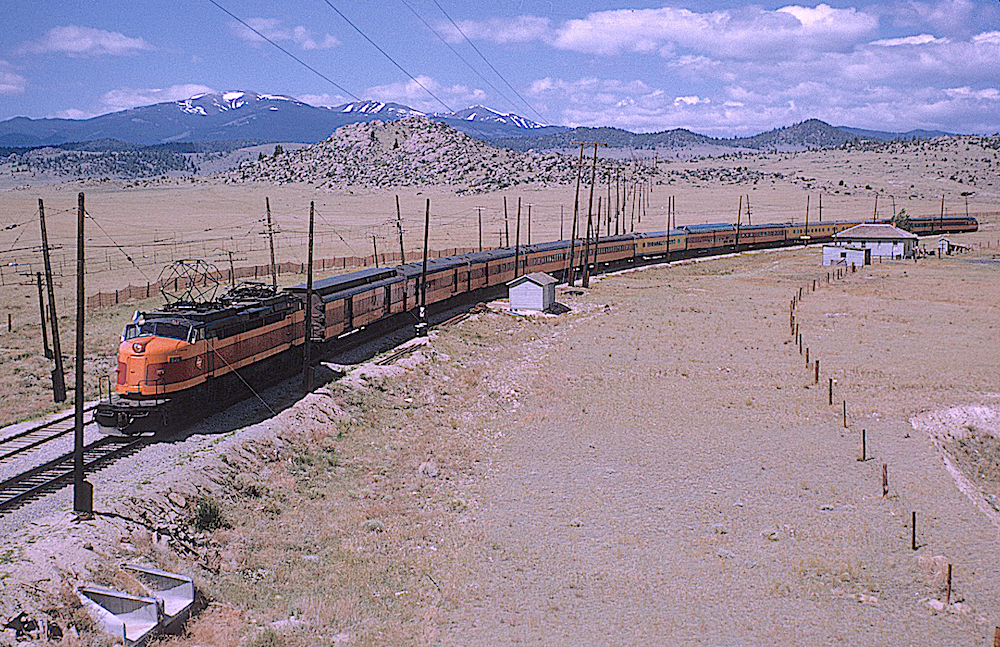
CMStP&P E-20 "Olympian Hiawatha" - WB Vendome, MT - June 7, 1956 - G Krambles Photo
Single-ended (the steam generator was in the rear cab) "Little Joe" locomotive E-20 has the
"Olympian Hiawatha" in tow past Vendome, MT. This was tough railroading country, either way
from Vendome (elevation - 4,810 feet), the line rose substantially. In the 6 miles east to
Piedmont, the elevation of the line rose 455 feet, while heading the other way (west towards
Cedric), the climb was 368 feet over just 4 miles.
Milwaukee had operated an "Olympian" since 1911; the train graduated to the "Hiawatha" branding
from June 29, 1947. Six sets of new streamlined equipment (including the famous "Skytop"
sleeper-observations) were delivered from P-S that year. Milwaukee returned to P-S for six
(out of 10) "Super-Domes" to be assigned to this train (see the 7th car back in this consist).
Locomotives E-20 and E-21 began running in place of diesels on the "Olympian" over the
Montana-Idaho electrified zone from March of 1952. Their assignment as passenger locomotives
was short-lived. In the interest of improving locomotive utilization, the pair were converted
to freight service during 1956
|
|
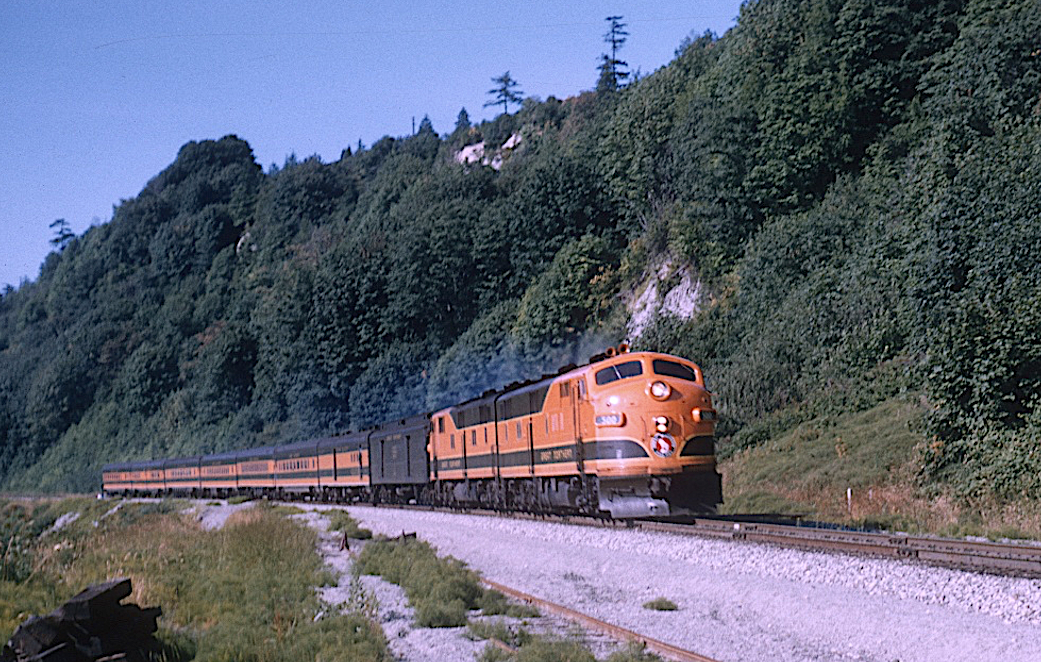
GN E7 500 "Morning International" - SB near Ballard, WA - July 7, 1957
The condition of that GN E7 up-front on this "Morning International" has always grabbed my
attention! Not bad for a 12-year-old locomotive (s/n 2825; built 4/45)?!? Sadly, there's
no name on the mount, so this great image can't be attributed. GN didn't hesitate to commit
capital to upgrade its passenger services. In the five years from 1947, the road spent $22
million on new, streamlined trains. These include the flagship "Empire Builder,"" the "Western
Star,"" the "Red River" and the three-times-daily "Internationals." Each 5-car "International"
represented an investment of $875,000.
<>
GN also heavily promoted the service, slashing fares by 32% from January 1950. Earnings on
the "Internationals" responded accordingly - up 23% compared to the results for the previous
year. However, by 1955, GN was running a passenger deficit of $22 million. Loss of the mail
contract caused the road to discontinue two evening trains on this corridor in mid-1960. The
morning train-pair was eliminated during 1969.
As for E7 500, it continued to remain in service until the BN merger, being renumbered to 9901.
The locomotive was sold to PNC on March 18, 1971. |
|
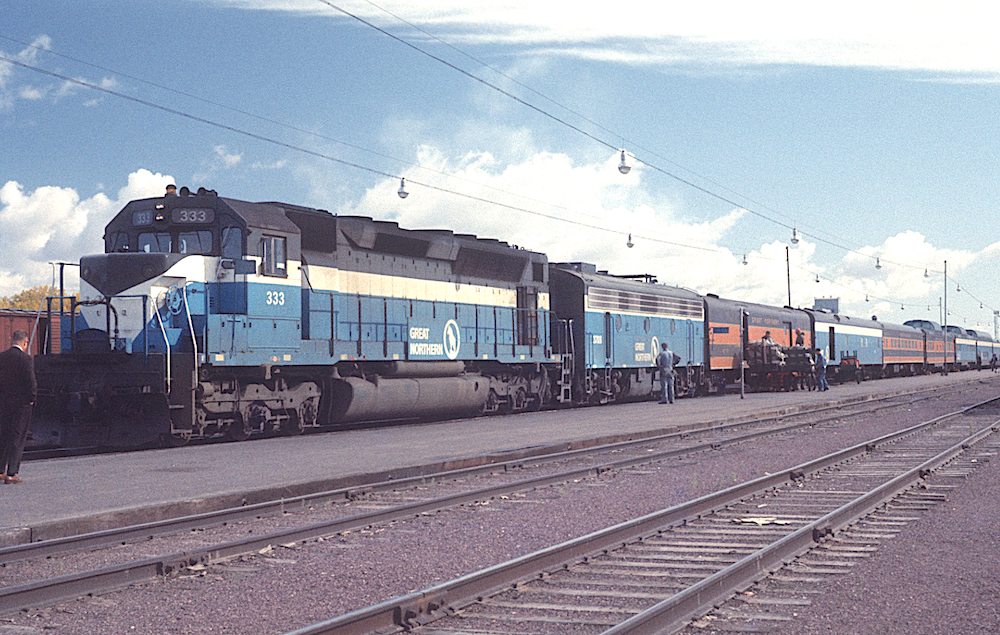
GN SDP45 333 "Empire Builder" - WB Havre, MT - October 2, 1968 - G Krambles Photo
One-of-a-Kind: Only on the GN could you find both SDP40s and SDP45s. A little over a year
old, SDP45 333 (dressed in the handsome "Big Sky Blue" image) is shown during the servicing
stop in Havre. You might not normally think of this as high-speed territory, but for the 87.4
miles from Malta to Havre, this train had rolled off the miles at an average speed of 69.9 mph.
On the CB&Q, the combined "Empire Builder"/ "North Coast Limited" hustled west out of Aurora at
an average speed of 75.9 mph for the 60+ miles to Oregon, IL.
Despite GN's seeming "do it right or don't do it at all" philosophy towards its passenger
services, these were tough times for the "Builder."" The train had remained profitable through
1966, but the 1967 cancellation of the train's RPO meant that it incurred a direct cost loss
of $8 million in 1968. Despite the bad tidings, the train would remain on the timecard till
the dawn of Amtrak, which has operated an "Empire Builder" ever since. |
|
Acknowledgements: As noted in the introductory text, Bill Krattville's "Steam, Steel & Limiteds" was a valuable resource; as was Fred Frailey's "Twilight of the Great Trains."" Joe Welsh's book on UP passenger trains was also of considerable use. Back issues of "Trains" magazine and "X2200S," as well as "The Second Diesel Spotter's Guide," along with numerous websites were also consulted.
|