A Few Hours At Cresson / Gallitzin in 1985Photos by Dennis Smolinski |
||||||||||||||||||||||||||||||||||
|---|---|---|---|---|---|---|---|---|---|---|---|---|---|---|---|---|---|---|---|---|---|---|---|---|---|---|---|---|---|---|---|---|---|---|
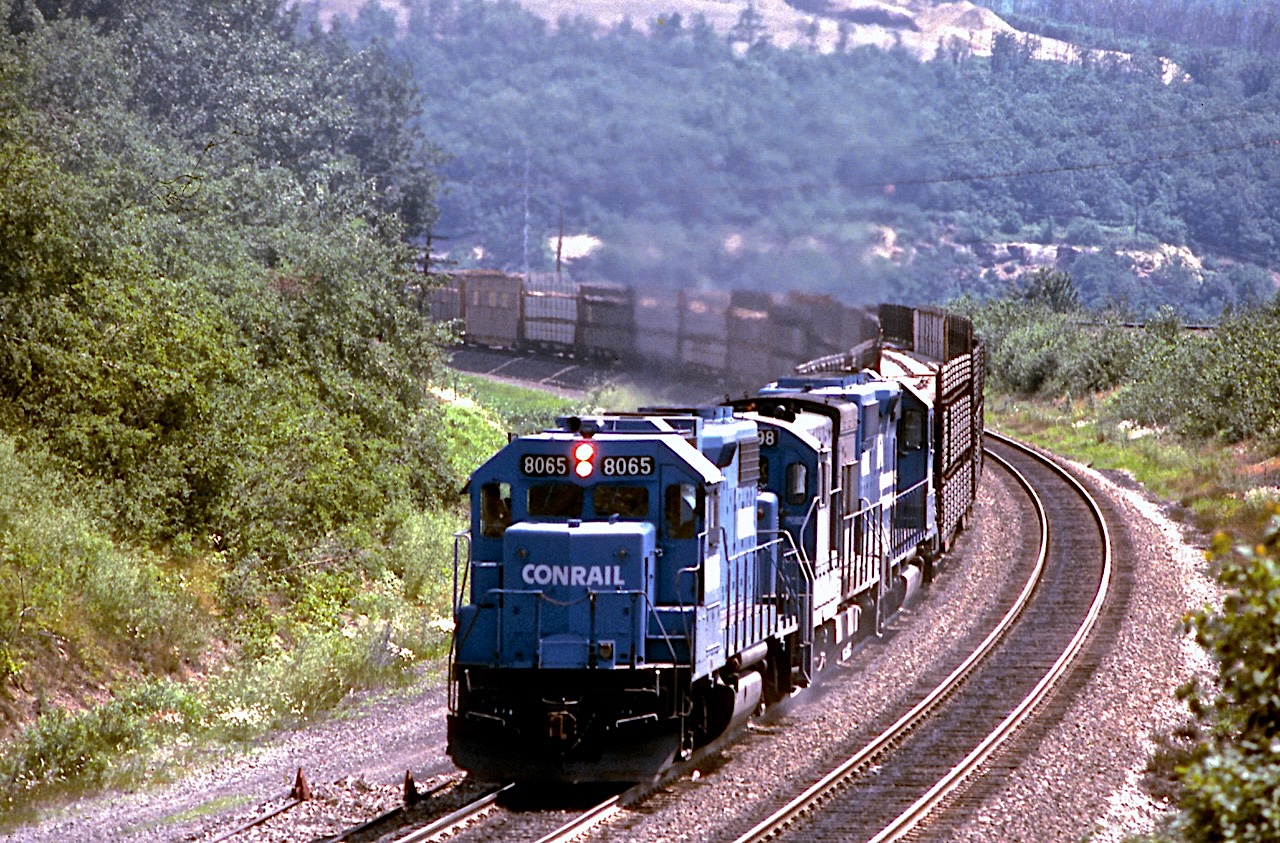 Conrail GP38-2 #8065 leads an empty autorack train up the east slope of the Alleghenies at Gallitzin on 24 July 1985 |
||||||||||||||||||||||||||||||||||
On 24 July 1985, Dennis Smolinski and a friend while returning home after attending a four-day railfan gathering in the east took a detour and visited Conrail's Summit of the Allegheny Mountains. Although the time allotted to the sidetrip was limited due to other commitments, they had a front-row seat to non-stop Conrail action. During the mid-1980s, some of the finest railroad watching in the eastern half of the country was located along the mainlines of Conrail. And the most popular railfan spot above all the rest was CR's crossing of the Allegheny Mountains especially Cresson and Gallitzin. For the uninitiated, MO Tower in Cresson was at the center of activity with three busy east-west mainlines, helper sets, a locomotive maintenance facility with fuel rack and sanding station, plus two branch lines that generated coal traffic. Lastly, "Big Blue" locomotive were very photogenic. Dennis' willingness to share photos of that afternoon are appreciated. Enjoy!
Photo Gallery
Conrail B36-7 #5017. Conrail ordered sixty high-hosepower road units (#5000-5059) from
General Electric; they all arrived during the latter part of 1983. The 3600-hp speedsters were
specifically purchased to expedite intermodal freights. The #5017 depicted here holds the point
position on a eastbound intermodal. In the background, an autorack train heads for the east
portals at Gallitzin's Tunnel Hill. 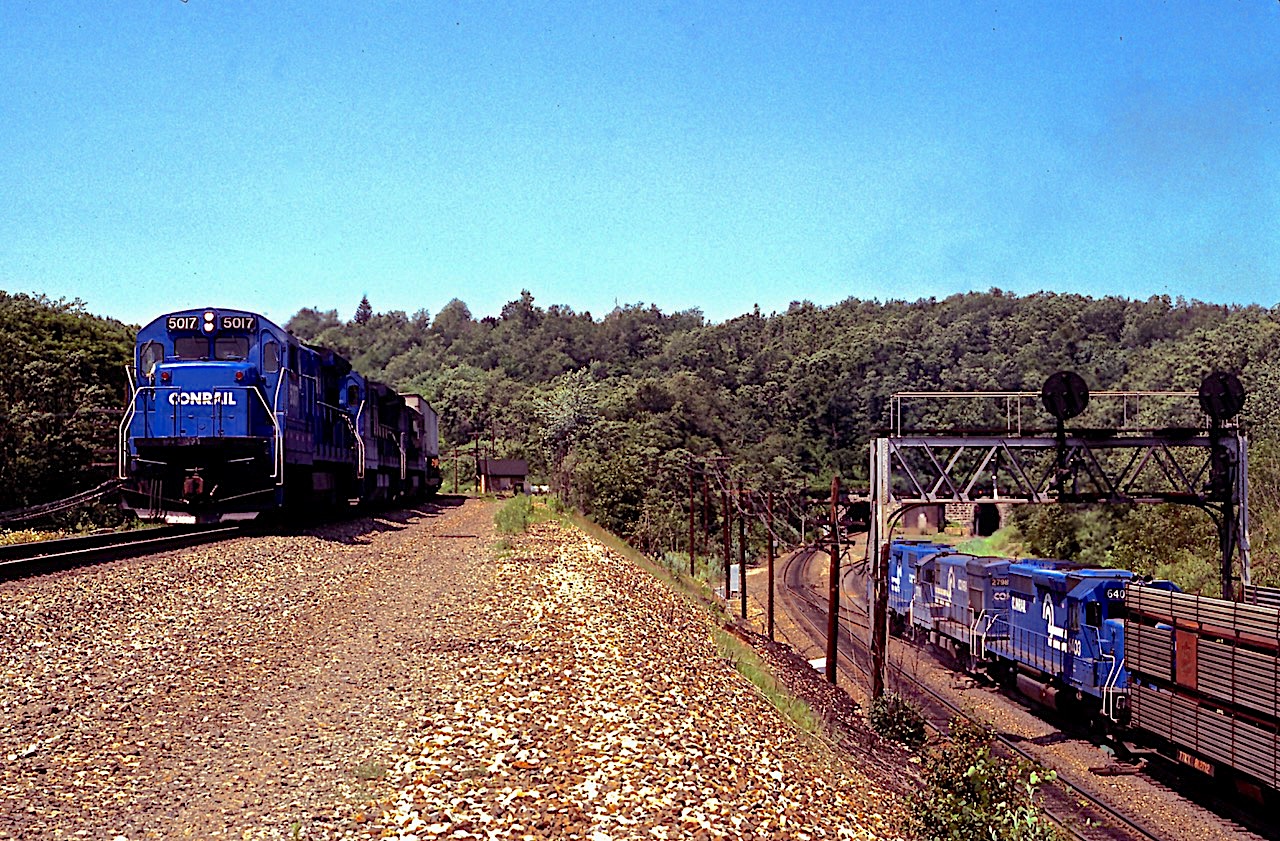 blank | 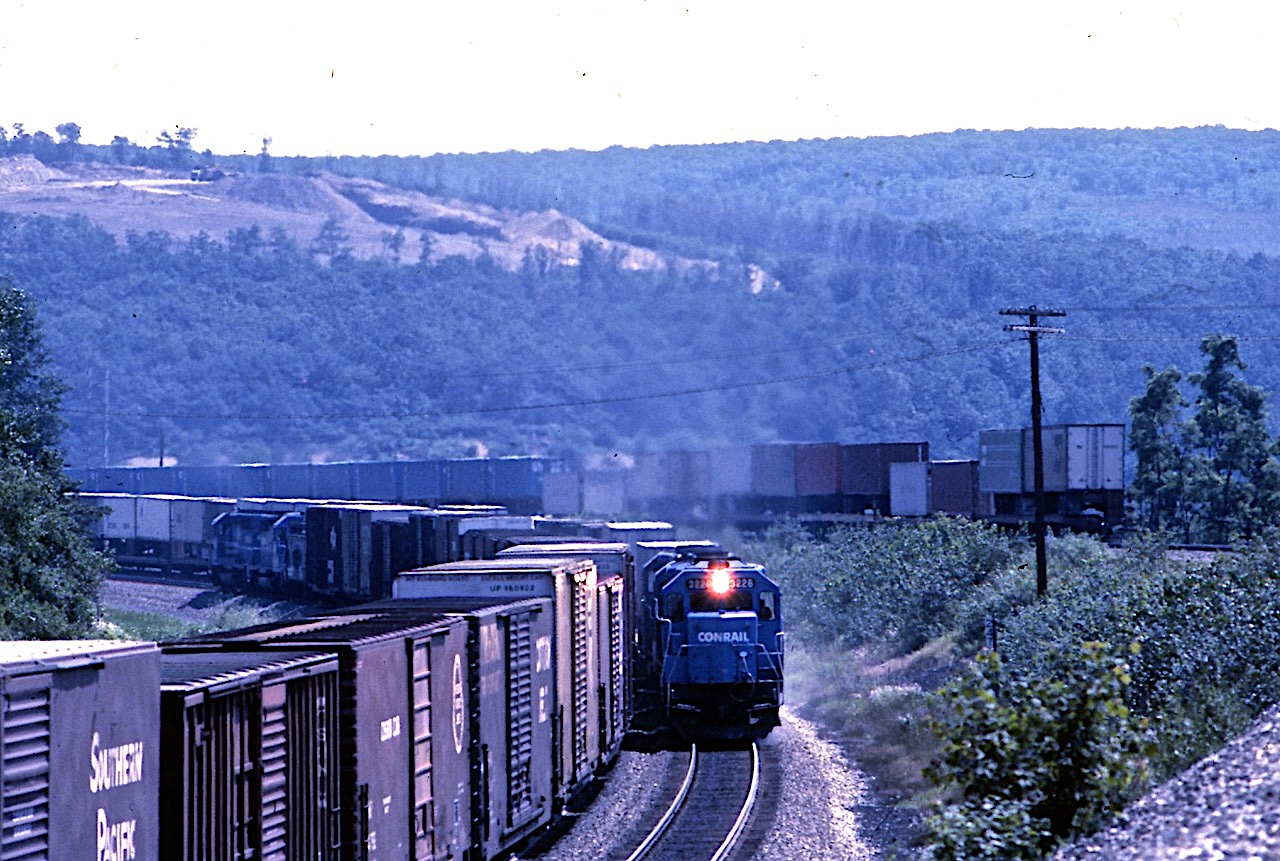
Conrail GP40-2 #3226. As the CR 5017 led intermodal glides downnhill in the background,
two more trains filled the camera's viewfinder. The #3226 and two other four-axle EMDs charged
uphill with a westbound van-train, while a pair of six-axle EMDs descented the Gallitzin hill
leading a merchandiser. blank |
Helpers. The ruling grade at Gallitzin was a challenging 2.28 per cent. Prior to
departing Altoona (eight rail miles to the east), a pair of SD40-2 pushers (CR #6278 and 6244)
were added to the rear of this intermodal train to help lift it over the hill. The SDs' six
additional axles provided another 164,000 pounds of tractive force. 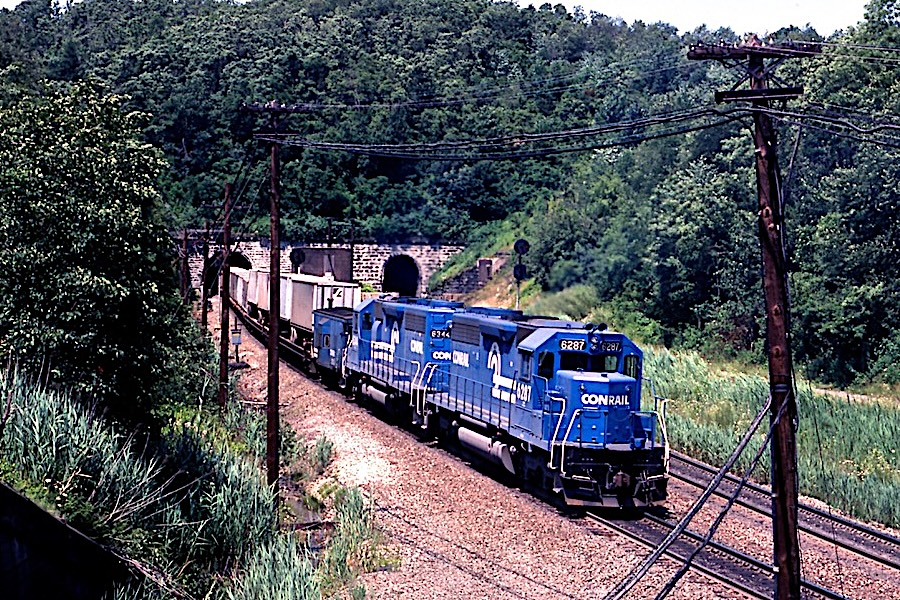 blank | 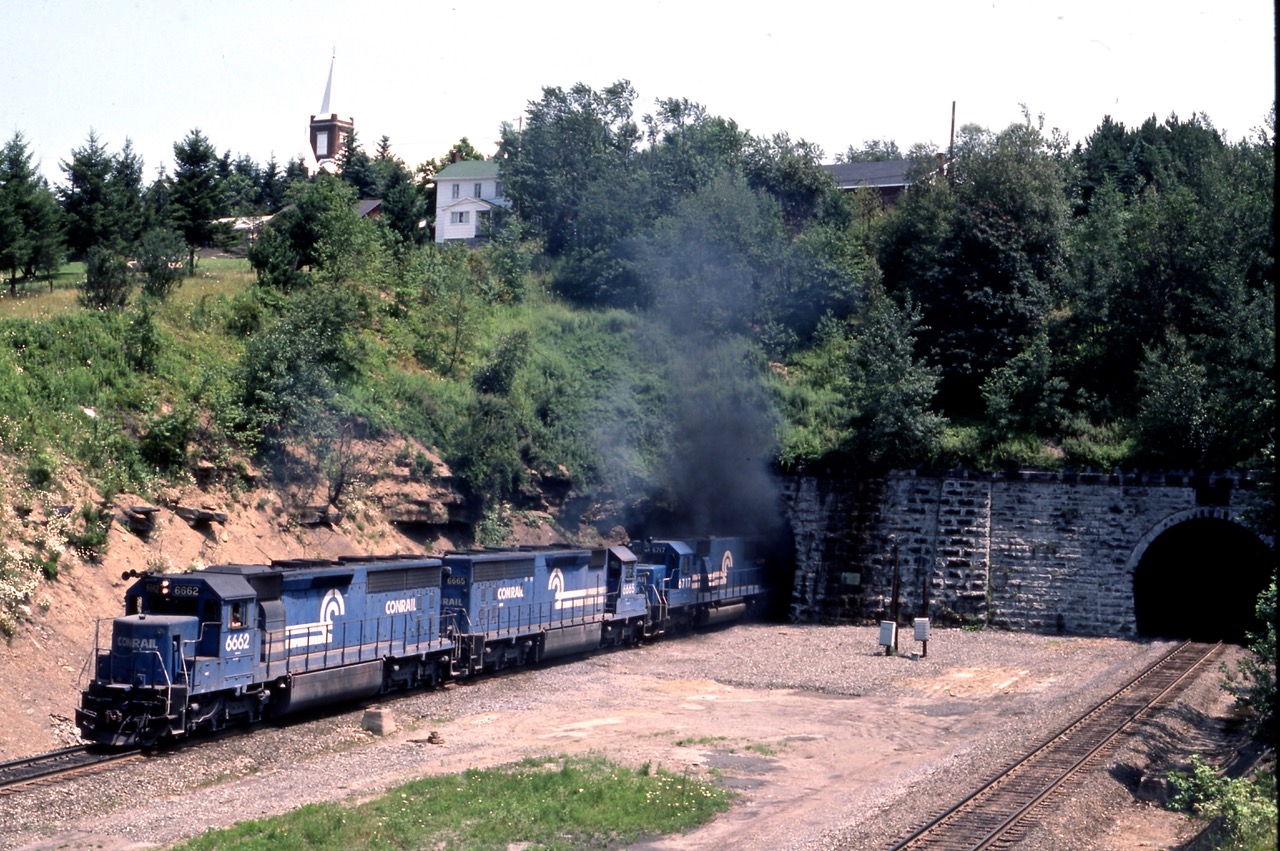
SD45-2s. Of all of the railroads that owned the SD45-2 model, Conrail's fleet (#6654-6666)
was the smallest. The thirteen units had been built originally for the Erie-Lackawanna (#3669-3681)
in late 1972, and the bankrupt EL conveyed the six-axle EMDs to Conrail at the time of the 1976
merger. Two of the 69-foot freight motors were caught exiting the west portal of the Gallitzin
Tunnel in the company of a single SD50, #6717. blank |
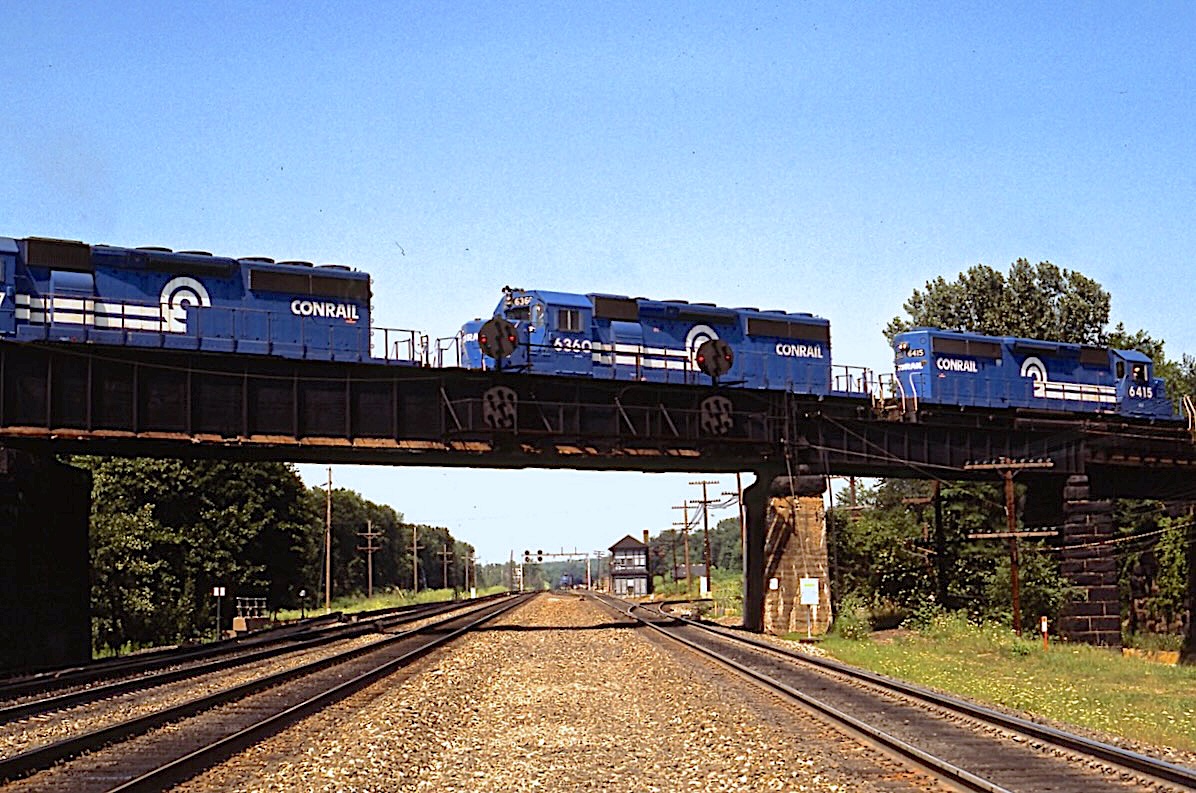
Cresson Secondary Flyover. When this picture was snapped, the flyover had stood watch
over the mainlines of the Pennsylvania RR, Penn Central and Conrail for the better part of
possibly eight decades. (The exact date of construction appears to be unknown.) On very
early maps, it was shown as the Black Lick secondary. Besides handling coal trains
to/from the Cambria & Indiana railway, it also served as a shortcut for locomotive power
between the MOW yard and the helper stations beyond MO Tower. Additionally, the bridge
sometimes served as a photography platform for enthusiastic railfans.
  blank |
Diversified Traffic. One of the attractions of Cresson was a good foundation of
diversified traffic. In the days before railroad scanners and internet-based GPS apps, there
was plenty of guesswork as to how long before the next headlight would appear on the horizon.
On this particular day, the apparent wait was never long and the diverse traffic plentiful:
Several intermodals, a slow coal drag, a long merchandizer, and a hot mail train, plus Amtrak
tossed-in a daily passenger train for added viewing pleasure. The Cresson passenger depot once
stood where the tracks bowed 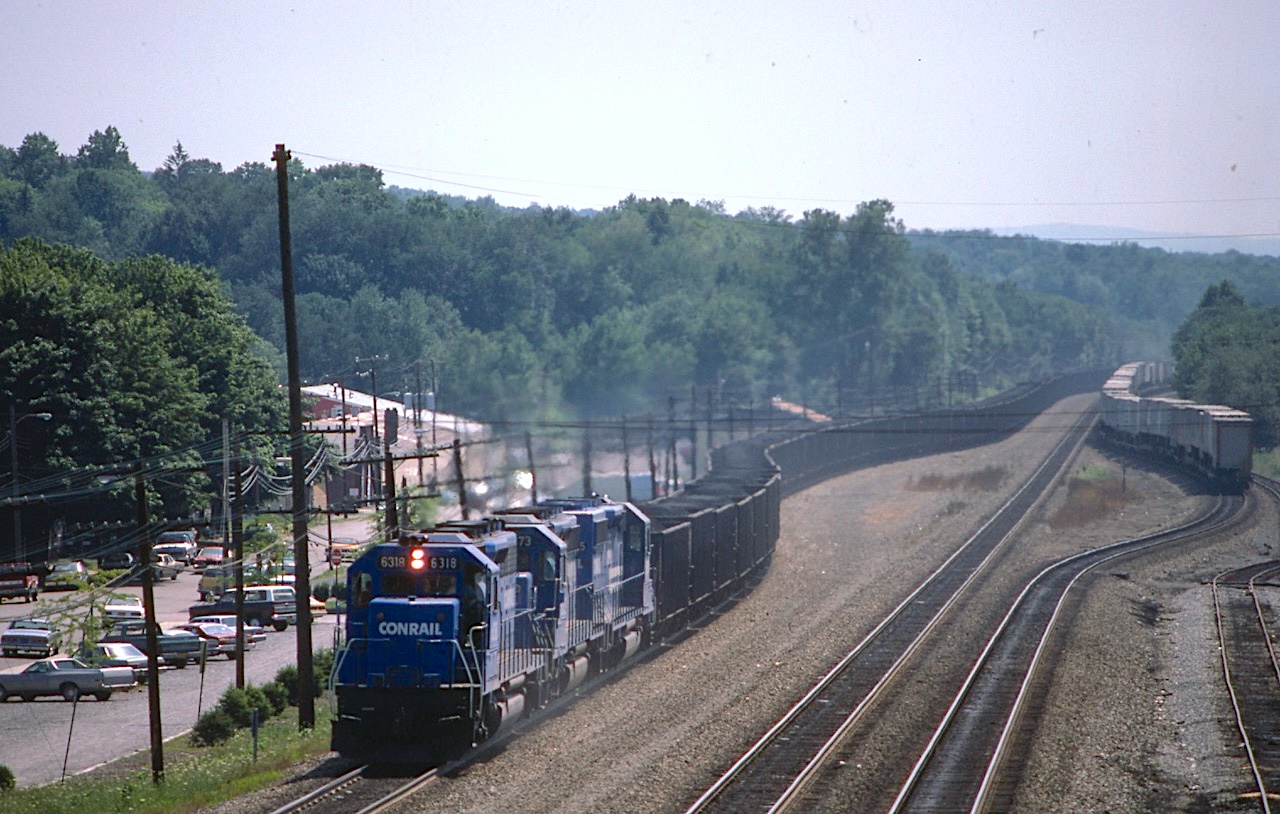 blank | 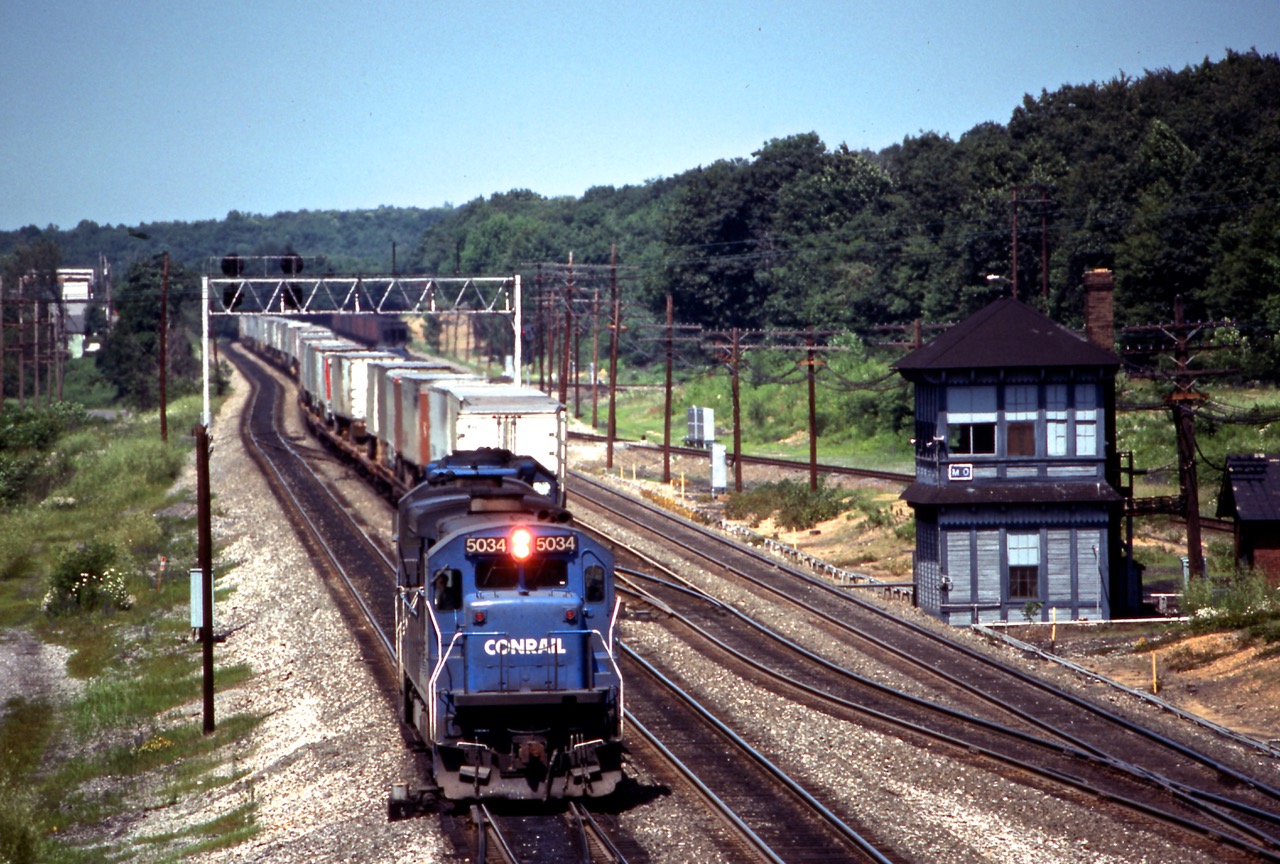
Trailer Van Trains. By the mid-1980s, Conrail had shown the U.S. Government, Wall
Street analysts and investors, and pretty much the entire rail industry that it knew how to
be profitable. Intermodal service which had been one of key the components was growing with no
immediate end in sight. Conrail understood the intermodal needs of shippers and catered to the
market through a series of Trailer Van (TV) trains. The railroad's timetable contained nearly
30 separate TV-XX trains -- odd numbers westbound and even numbers in the opposite direction.
CR B36-7 #5034 led one of the five TV trains spotted during that afternoon visit. blank |
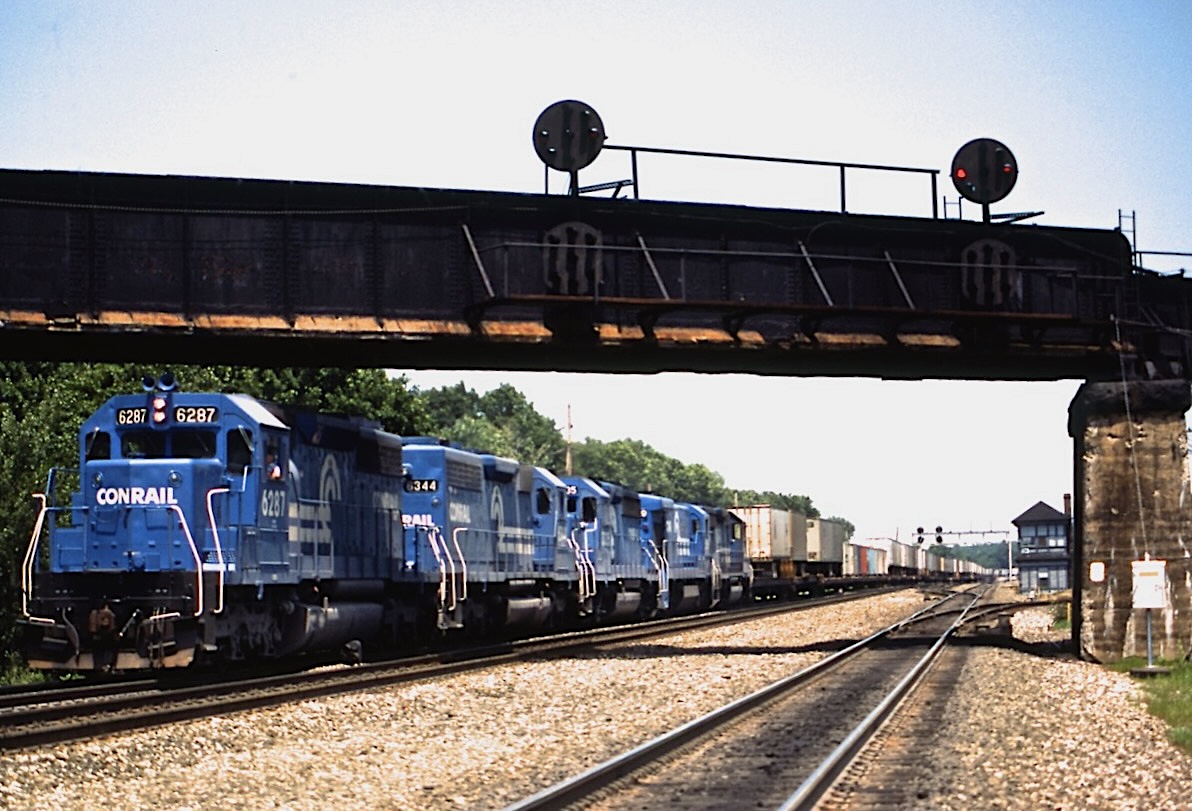
MO Tower. Situated at Milepost 250.5 on the Pittsburgh Line, Conrail's 96-year-old
MO Tower looked in pretty decent shape. One of several existing interlocking plants still
operational on the CR system, the busy facility controlled interchange traffic through
crossovers, on two branch lines and a near-by locomotive maintenance shop. The advent of
fibre-optics led to the tower's demise in 1998. This Smolinski photo shows a quartet of
high-horsepower GP40-2s pounding past MO with a hot trailer-van train. It was the kind of
scene repeated frequently along Cresson's three mainlines. 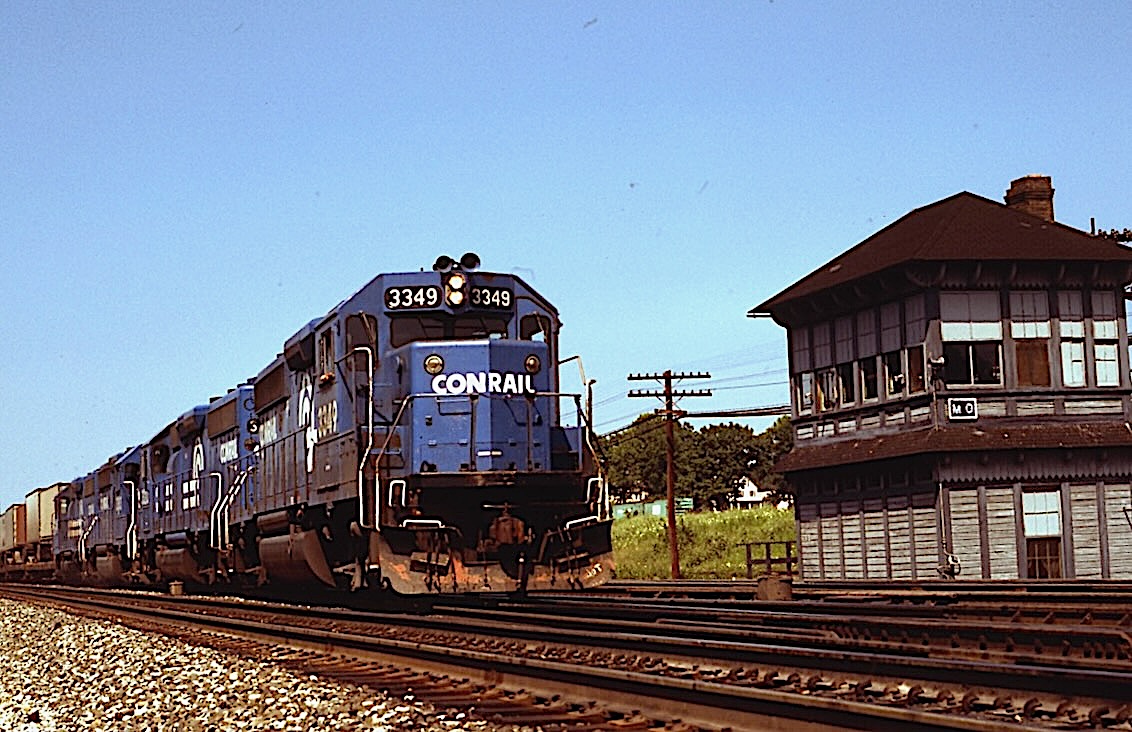 blank | 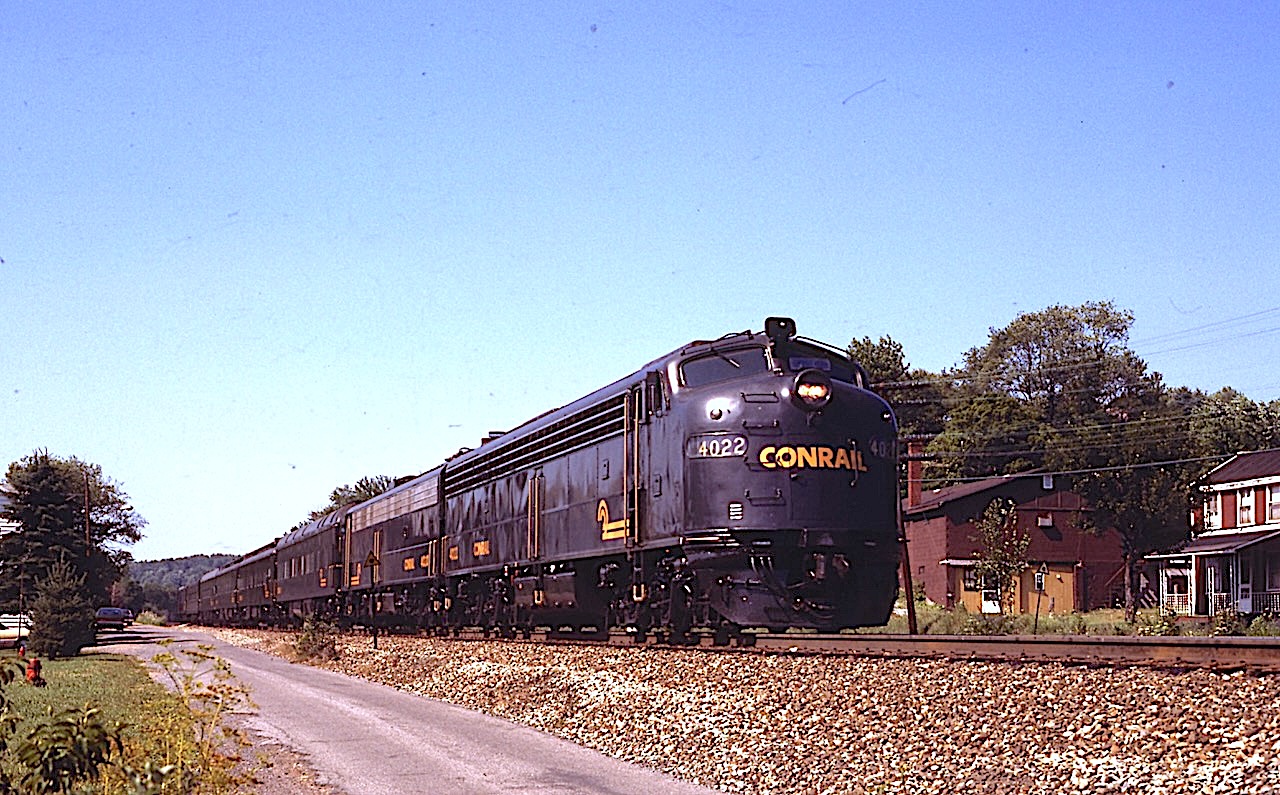
Office Car Special. During Conrail's twenty-three year existence (1976-1999), the
Office Car Special (OCS) was the probably most popular and widely photographed train on the
system. Predominantly powered by the railroad's three remaining EMD-built cab units (#4020,
4021 or 4022), an OCS could take many forms depending on the train's purpose: economic development,
employee relations, director's special, and Operation Life Safety. So, imagine the odds and the
photographer's surprise in catching Conrail E8A #4022 and 4020 rolling a seven-car special
eastbound through Cresson.
| Text supplied by R. Craig
| |||||||||||||||||||||||||