What's In A Name? California & Southwest EditionAll photos from the Krambles-Peterson Archive
Text by Art Peterson |
|
|---|---|
Use of distinctive names to identify the premiere train(s) on a route did not come into practice until nearly two decades after passenger trains first began operating in the US. The 1847 naming of the "Fall River Boat Train" is credited with beginning this practice, which reached its zenith around the time of World War One. As Bill Kratville noted in his superb book "Steam, Steel and Limiteds" these train names would become "household words." Thanks to the publicity skills of George Henry Daniels (and others), names like the "20th Century Limited" immediately suggested the notion of luxury, fine dining and the scenery of the water level route. The same was true of the many other fine named trains of the era. Even into 1950, the US still boasted some 350 name trains in operation. This series celebrates those once-familiar name trains on a regional basis. Each installment includes five trains, with the photos presented in chronological order. Since this feature is appearing on "The Diesel Shop" site, it also includes a variety of the diesels that were once in command of the name trains. Apologies if your favorite road/limited/locomotive model isn't included in this series. |
|
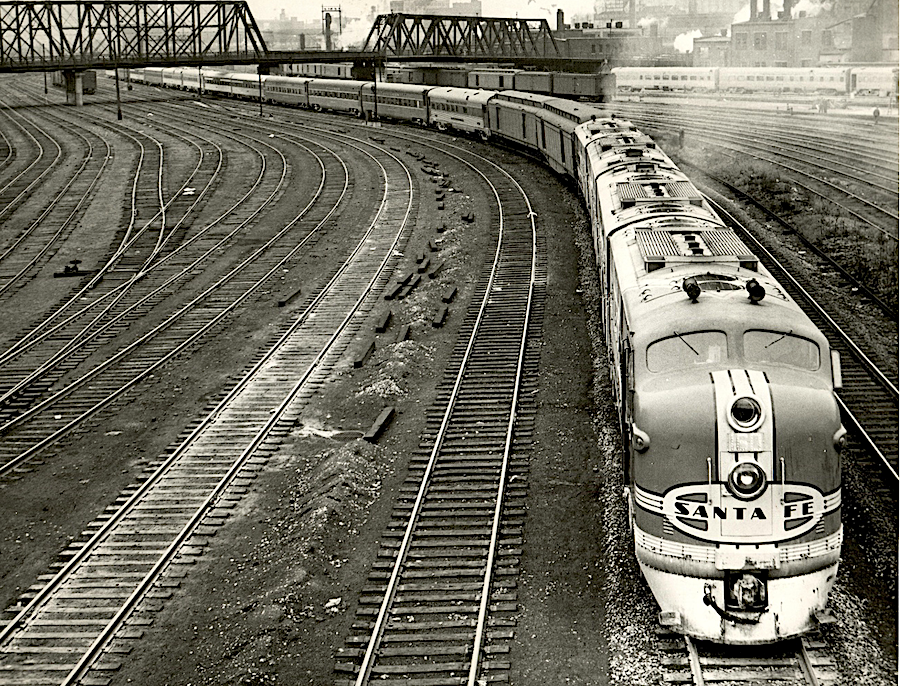
Santa Fe FT 160 "The Chief" - Chicago, IL - June 2, 1946 - Santa Fe Photo
To dieselize "The Chief" and reduce helper requirements over Raton Pass, the Santa Fe
purchased one new A-B-B-A set of passenger-equipped FTs from EMD, along with converting another 10
A-B-B-A sets to passenger service. FTA 160 above, had been built in December 1945 and was
initially assigned to freight service; the following April, the set was rebuilt for passenger
service. Receipt of passenger-equipped F3s allowed this set to be restored to its freight
configuration/paint scheme from May 1948.
The company photographer has also captured the era in which "The Chief" was handling three
transcontinental sleepers (one each from the B&O, NYC and PRR). Retired Santa Fe engineman
Phil Gosney notes the cars in this consist are still lettered "Pullman," pre-dating the
government-mandated divestiture of 1948 (the image only carried the "June 2" date in its
original caption).
|
|
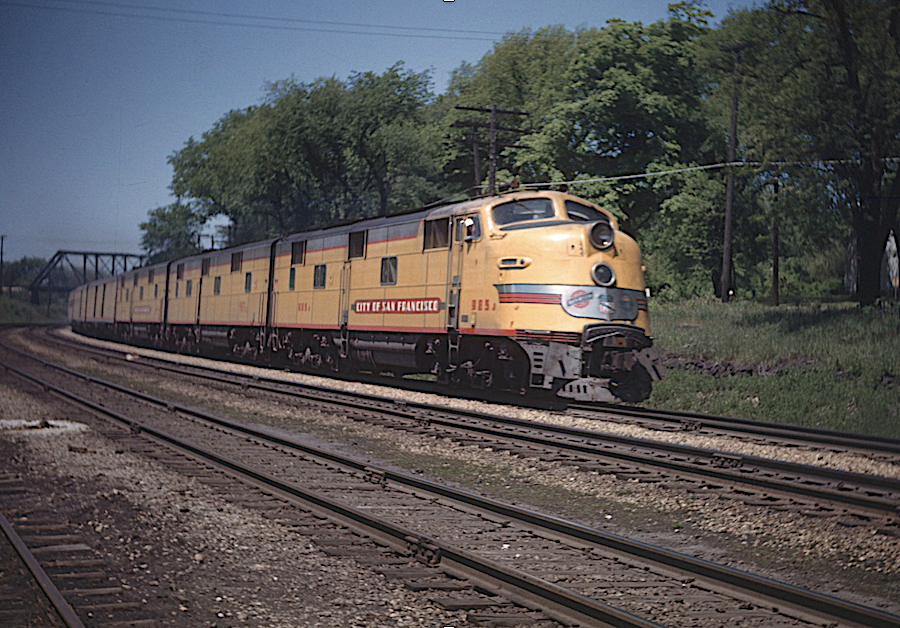
UP E6 985J - "City of San Francisco" - EB Wheaton, IL - 1948 - G Krambles Photo
In the Wheaton area to shoot Chicago Aurora & Elgin action (the bridge visible above and to
the immediate left of this train carried the interurban's branch to Elgin), George caught the EB
"City of San Francisco" on its homeward sprint to Chicago. Up front is E6 985J. Built as part
of the SF-4 set (s/n 1175, March 1941), this unit was first renumbered to 904 in August 1946.
It assumed the 985J (J indicating "joint") in March 1948 and would join the C&NW roster as the
5004A in December 1948. This unit went to scrap during 1959.
The Northwestern, UP and the SP began daily operation of the "City of San Francisco" from
September 1, 1947. "Trains" magazine noted that the UP-SP were now fielding 16 through trains
on the Omaha-San Francisco run vs. nine such trains in 1929. Extra-fare was charged to ride
the "City of San Francisco" ($15.00 for the complete San Francisco-Chicago journey), which
offered barber, stewardess and valet services. Compartment, Double Bedroom, Duplex Single
Bedroom, Drawing Room, Roomette and Section accommodations were available on this train
|
|
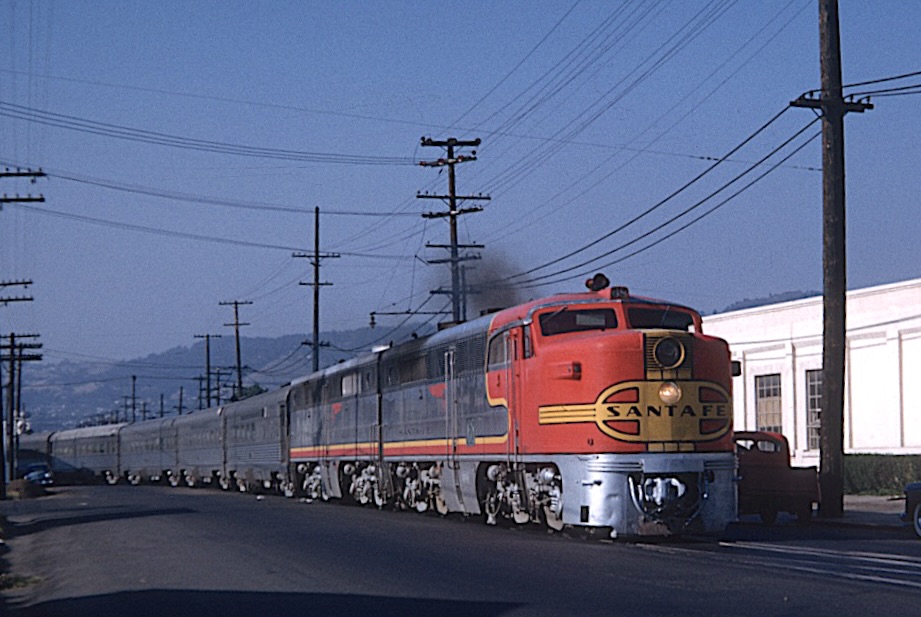
Santa Fe PA1 68 "Golden Gate" - NB Berkeley, CA - June 7, 1951 - BL Stone Photo
Santa Fe intended the "Golden Gate" trains to compete directly with the SP "Daylight"
service. The combination of fast running by the train on the Bakersfield-Berkeley rail run,
combined with expedited operation of Santa Fe Trailways buses at either end of the rail
operation allowed Santa Fe to meet the SP's running time. Automatic Train Stop, allowing 90
mph operation, was ultimately installed between Bakersfield and Mormon Yard (east of Stockton).
New, Budd-built streamlined equipment was used from the July 1, 1938 start-up, with many of
these cars remaining active on this assignment until the April 12, 1965 discontinuance of the
"Golden Gates." The observation cars had come off around 1960, while newer lunch counter-diners
substituted for the original Budd lunch counter-diner.
PA-1 68 upfront in this shot, had been built as 56B in June of 1947. The locomotive was
renumbered in May 1949. It was traded-in to EMD during 1969. |
|
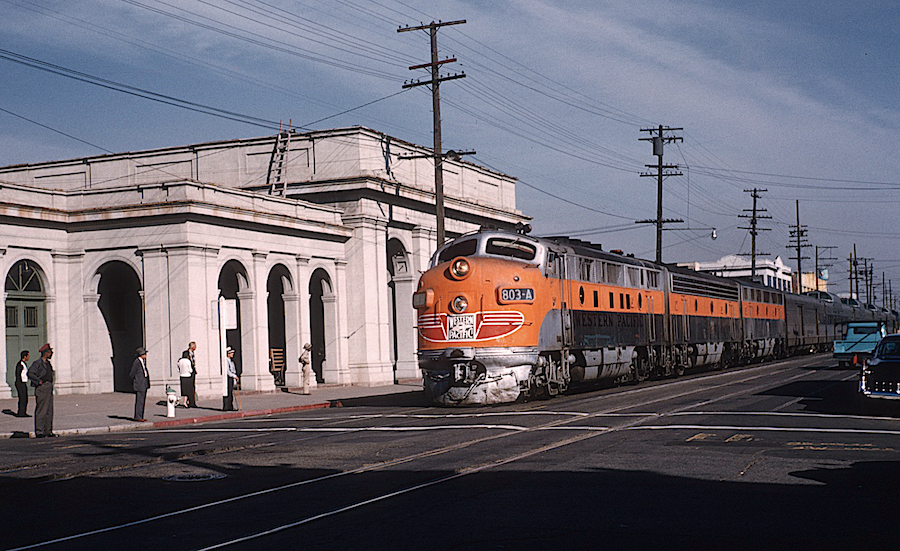
WP F3 803A "California Zephyr" - WB Oakland, CA - September 1959 - JR Williams Photo
Headed by one of the three F3As that was originally bought (ordered in August 1945, built
in June 1947) to equip the "Exposition Flyer" and then transition to "California Zephyr" service
(configured as three A-B-B sets), the shimmering land-cruise train arrives at its Oakland, CA
station, not long after the train's 10th anniversary (May 1959). The three partner roads
ordered 66 cars for this service in October 1945, supplemented by an additional dozen cars
acquired in 1952.
Advertised by the Burlington, the Rio Grande and the Western Pacific as "the most talked-about
train in the country" ("Trains,"" November 1950), the train was still able to boast 90% summer
load factors into 1959. By its 10th anniversary, the "Zephyr" had grossed over $75 million and
carried more than 1.5 million passengers. These numbers masked the fact that WP had been losing
money on the train since 1956. For the Burlington and the Rio Grande, profitability would slip
away in the mid-sixties.
The "Trains" 1959 speed survey found the "CZ" covering more than 300 miles (in Iowa, Nebraska
and Colorado) at average speeds in excess of 70 mph. On the WP, a further 121 miles (from Salt
Lake City to Wendover) required the train to average 70.2 mph.
|
|
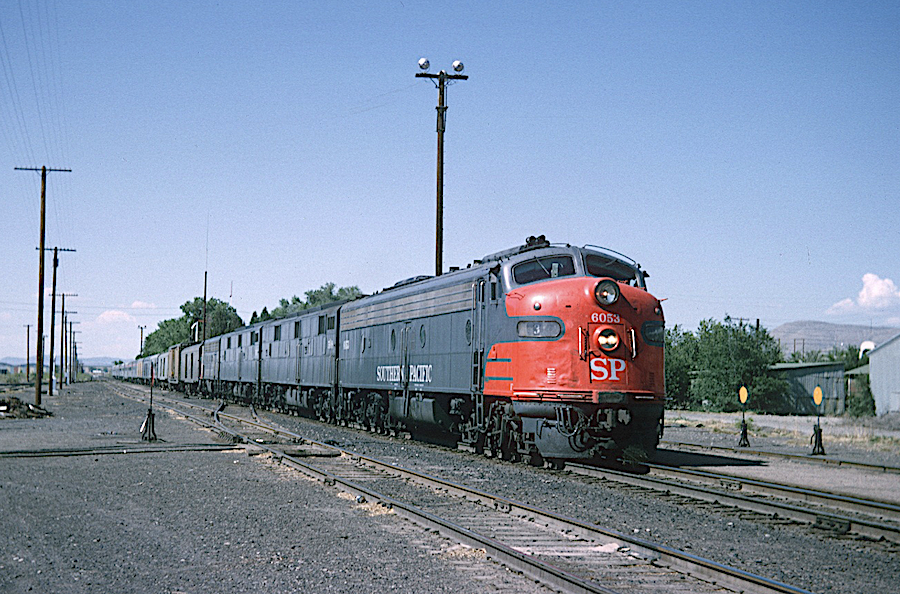
SP E9 6053 "Golden State" - WB Alamogordo, NM - May 1965 - R Ward Photo
Time makes the heart grow fonder - SP's scarlet & grey image may not have been well-received
when introduced, but this consist looks very stylish from the perspective of 60 years later!
SP power has been in charge of the train for the past 246 miles (since Tucumcari). Eighty-five
miles to the west, in El Paso, the "Golden State" consist will be combined with that of the
"Sunset Limited" for the final 900 miles into Los Angeles.
Consistent with the "Golden State's" extra-fare status ($7.50 for the Chicago-Los Angeles run
at the time of this photo), the train still offered the necessary luxury accommodations and speed
required of a limited. On the Rock Island, it was scheduled to operate at an average speed of
nearly 72 mph for more than 155 miles, while SP wheeled it through Arizona at more than 70 mph
for a distance of 32.7 miles.
Four cars back in the consist is the train's Chicago-Los Angeles RPO. Elimination of this
business would reduce the train's income by $3 million. On top of that, the Rock and SP would
estimate passenger loadings off 20% for the first nine months of 1967, compared to the previous
year, leading to an annual loss of $1.8 million. The ICC allowed the "Golden State's"
discontinuance to be effective February 21, 1968.
|
|
If you missed Part 1 hit the link and review Art's discussion on Pacific Northwest passenger trains. |
|
Acknowledgements: As noted in the introductory text, Bill Krattville's "Steam, Steel & Limiteds" was a valuable resource; as was Robert Reed's "The Streamline Era." Fred Frailey's "Twilight of the Great Trains" was a valuable reference. Phil Gosney provided specific operating/equipment information. Back issues of "Trains" magazine and "X2200 South," as well as Lou Marre's "Rock Island Diesel Locomotives," along with numerous websites were also consulted.
|